Finally, somewhere to put your drink that isn't the console.
122 reviews · 4.9 average · 98 verified purchases
Steadi Labs LLC — Scott Rodriguez, founder. Veteran founded.
3419 E Chapman Ave #411, Orange, California · hello@steadilabs.com
“First time I have ever ordered from Facebook feed. Very easy. Happy with product.”Steve Butler · 8 August 2026
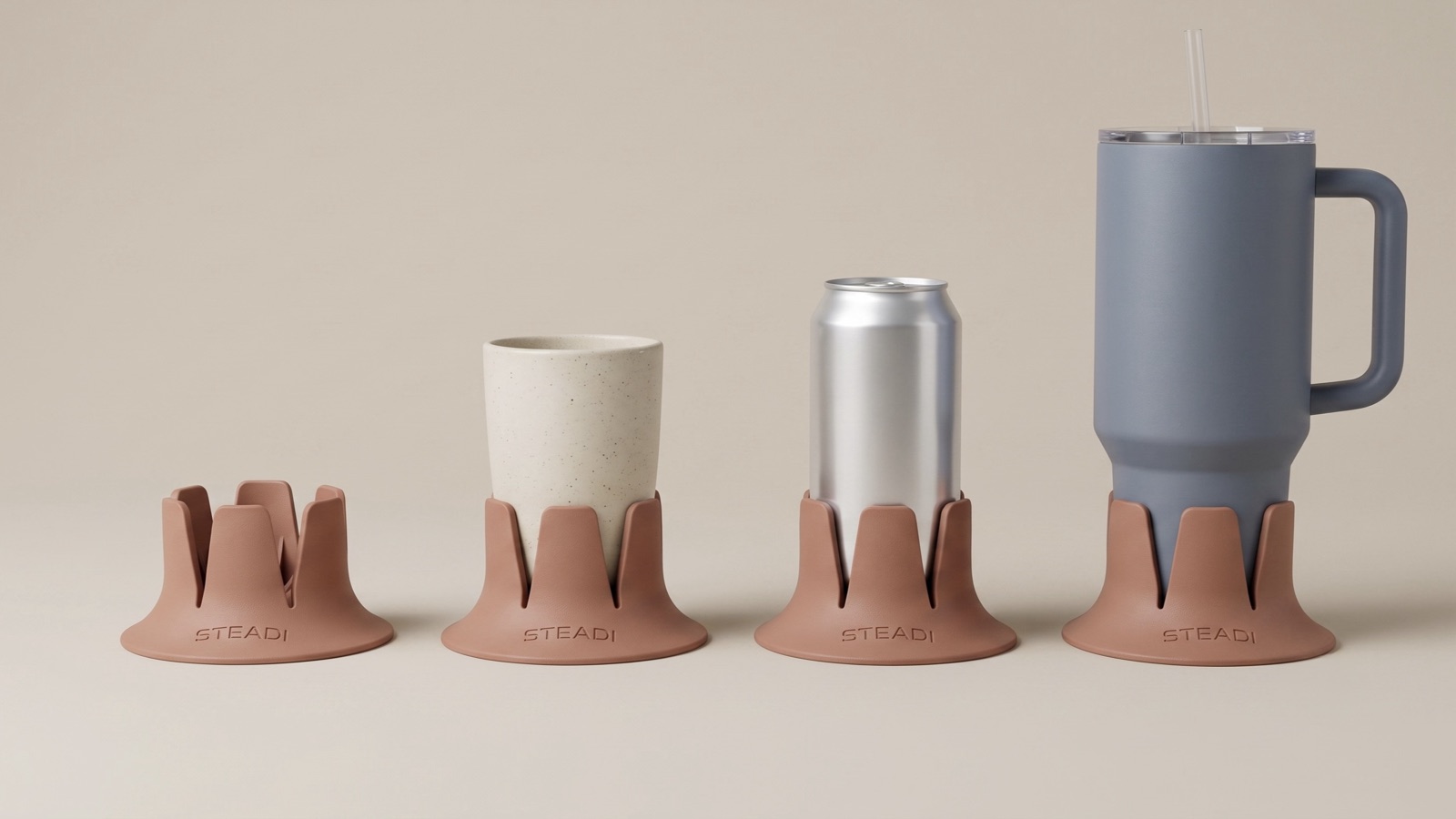
A flexible-finned base that plants on the console, the rack top, or the booth floor and holds whatever's in reach — no clamp to fit, no tube diameter to match first.
Get one for the booth — from $14.95Free shipping · 90 days to run it on your actual gear, full refund if it doesn't earn a spot near the mic.
Will your tumbler clear the console? A sticky note answers it before the red light goes on ↓
As it stands
Every studio posts the no-drinks rule. Every studio breaks it.
Dry mouth reads as a click in the finished track, and compression only turns it up — so the water has to stay within reach of the mic. Nothing in a booth or a control room was actually built to hold it there.
The flat strip above the faders is the nearest shelf to the engineer's hand, and every fader travels through an open slot cut straight into the console top. Forum spill threads describe coffee and whiskey finding a direct line down to the power supply and the XLR jacks — the kind of afternoon that ends with the board sent out for repair.
A prefab iso booth runs close to four feet a side outside and noticeably less within — room for a mic stand, a tilted pencil tray, and not much else. The tea or the water ends up on the floor by the stand's feet, in the dark, exactly where a foot and a headphone cable both move.
Keyboard, mouse, MIDI controller, interface — there's no dead space left on purpose, so the cup takes whichever gap opens up. A blind reach mid-edit, eyes still on the timeline, is how it tips toward the one thing in the room that costs the most to replace: the laptop underneath it.
A 19-inch rack reads as the nearest flat surface in a standing room, but the powered gear underneath vents straight up through the lid. A road case gets shifted mid-session too, taking whatever was balanced on it along for the ride.
Control rooms keep a couch behind the mix position for guests and the artist waiting their turn, and its rounded armrest is the one surface in the room that isn't wired to anything — so an open can lands there by default. One elbow off the cushion and it's rolling toward the rug the same as it would anywhere else in here.
None of it is a catastrophe. It's a decision that gets remade every session — where the drink sits until the take wraps — and studios have been quietly losing that call for years.
You've been here
You've already lived at least one of these takes.
The engineer's sleeve catches the coffee parked on the fader strip reaching for talkback — and it goes straight into the open slots mid-take.
The vocalist steps into the dim iso booth holding a honey-lemon tea, finds no table anywhere in a room barely wider than arm's reach, and sets it on the floor by the mic stand — where a foot finds it again two takes later.
Eyes locked on the timeline, the hand blind-reaches for the water bottle that's migrated behind the keyboard, catches the shoulder instead of the base, and tips it toward the laptop.
The guest talks with their hands. The open sparkling water parked beside the boom-arm clamp catches a gesture and sheets across the mixer while both channels are recording.
Instant answer
The fit test lives right next to the meter bridge.
lands in here
A square sticky note: 3 inches, exactly — same as the ceiling of what clears the fader bank.
The standard square is exactly 3 inches on a side. That's a fact about sticky notes, and it happens to be the exact ceiling of what fits.
Look at the base, not the rim — a tumbler tapers and a can's rim flares, so the bottom is the only measurement that decides anything.
Base sits inside the square, it fits. Hangs past the edges, it's too wide. Rattles around loose in the middle — under 2 inches — and it's too narrow to grip.
No spec sheet, no tape measure hunting through the toolkit. One sticky note off the pad on the desk, and you know before the session starts.
Fit check
The bottom inch is the only spec that matters.
The rule is one line: a container base 2 to 3 inches across settles in. Every verdict below follows from that.
- 40 oz Stanley-style tumbler fits
- Insulated travel tumbler, sip lid fits
- Disposable water bottle fits
- Standard soda or sparkling water can fits
- Slim energy drink can fits
- Paper coffee cup, lid on fits
- Whiskey glass fits
- Handle-less travel cup (Throat Coat run) fits
- Throat Coat mug, handled handle in the way
- Espresso cup too narrow
There's a floor as well as a ceiling — under 2 inches, the base sits too loose to grip. The handled mug is the honest exception: the base fits the square, but the handle lands exactly where a fin needs to close.
The full fit database — Stanley, Red Bull, Yeti, and 30 more, with sourced base measurements →
Function
Built for a surface that isn't going soft.
On a console lid, a rack top, or a desk, the wide, low base contacts the whole surface at once — there's no round bottom hunting for a lip or a seam to wobble on.
Flexible fins hold the bottle, can, or cup by its bottom inch, so it doesn't walk when the nearfields hit the low end and the desk starts to vibrate.
A sleeve crosses the fader bank, a case gets shifted, an elbow catches it reaching for talkback — the base rocks back to level, low and wide, and the drink comes with it. It resists tipping; a glancing knock is exactly what it's built to shrug off.
Read the room
Every flat surface in here already has a job.
It isn't carelessness — the room genuinely has no surface built to hold a drink. Everything flat is either standardized rack space, vibrating with playback, or wired straight to something expensive underneath it.
In this room "spill" already had a meaning — sound bleeding between open mics — before a drink was ever involved. The literal kind finds the shorter route: fader travel is an open slot, not a sealed channel, wired straight down toward the meter bridge and the electronics under it.
Studio monitors flank the mix position at ear height, flat-topped and exactly at cup-parking height — and they vibrate with playback, which is how a container walks itself across the cabinet mid-mix instead of staying put.
Rack gear is measured to the inch — 19 inches wide by EIA standard, height in 1U units of 1.75 inches apiece. Every dimension up there is standardized except the one that would matter here, because a drink was never part of the spec. What's actually on top is a lid venting warm air off powered gear below, and a road case that gets shifted mid-session with whatever was resting on it.
The model number is the lie: a "4x4" iso booth measures its outside, and the inside runs closer to three foot ten on a side. What's left after a mic stand is a tilted pencil tray built for a lozenge tin, not a bottle — anything wider rolls off it and lands on the floor, in the dark, right where your own feet already are.
The standing studio rule is to keep any drink table lower than the gear, so a tip only ever reaches the floor. A laptop breaks that rule by definition — it sits right at desk height, in the same crowded inch as the keyboard, the mouse, and the MIDI controller, with nowhere lower for the cup to be instead.
Other routes
Every fix this room has already tried.
| A clamp-on mic-stand cup holder | The Recording Booth Cup Holder | |
|---|---|---|
| On a standard mic stand | That's the fit it's built for — holds fine | Doesn't need the stand at all — settles in just as steady nearby |
| Fits your stand's tube width | One narrow band of diameters — a mismatched tube doesn't clamp | No tube to match, ever |
| Whether the clamp stays snug | Reported to wobble loose until it's shimmed with washers | Nothing clamped, nothing to work loose |
| A slim can in an open-ring design | Can slip straight through when the stand gets bumped | Fins close fully around the base and hold steady |
| On the console lid or rack top | No stand there to clamp to — it doesn't reach | Plants flat on either, same as the booth floor |
| Moving it to a different session | Re-clamped and re-checked against the new stand's tube | Picked up and set down, no re-fit |
| Cost | Another purchase, sized to one stand | One small piece that fits wherever you set it |
Clamps wobble unless shimmed with washers, and each one only fits a narrow band of stand-tube diameters — a nonstandard cup doesn't fit the ring, and an open-ring design lets a slim can slip out the moment the stand gets bumped.
It only grips a desktop within a specific thickness window by the maker's own spec, which rules out a console lip, a rack top, or a booth wall outright — and it hangs the drink off the edge, right at knee-brush height.
The standing studio fix admits the real problem: the drink ends up behind the engineer or outside the booth, gets one sip, and drifts back toward the console anyway. A booth barely wider than an arm span has no floor left for a table in the first place.
Every room has one, and staff readily admit it holds almost nowhere — sessions run for hours, the voice needs water to stay click-free, and clients walk in already holding coffee. A rule with no approved place to set the cup just relocates where the spill happens.
Fair questions
You're probably thinking…
It's one piece of matte flexible material, no branding, in colors built for a rig — Control Room charcoal, Night Session navy — not shiny injection-molded plastic. Every photo on this page shows it sitting on real gear, not a white studio backdrop, because the aesthetic case has to be made in the image, not the copy.
Ask around a forum thread long enough and the story's already there: coffee down through an open fader slot into the power supply, a whiskey glass that ended a session with a repair ticket. It's not a hypothetical for this room — it's the version almost everyone who's tracked long enough has either lived or watched happen two feet away.
That's the exact failure mode this skips. Clamp-on holders grip one narrow band of tube diameters and work loose unless they're shimmed with washers; this doesn't clamp to anything — it plants flat on the console, the rack top, or the booth floor, and moves rooms without a re-fit.
The base range is 2 to 3 inches, floor and ceiling — a standard can runs about 2.6 inches, a Stanley-style tumbler about 3.1. Set it on a sticky note before you buy: 3 inches square is the exact ceiling of what fits, no spec sheet required.
It's less than one XLR cable, protecting gear you can name the replacement cost of. Run it for 90 days on your actual desk — if it doesn't earn a spot near the mic, it goes back, full refund.
From the reviews
What buyers say.
Recent reviews of the Steadi, from every room and rig it lives in.
I have a tendency to spill my drinks and have two cats. This is one of the best things I’ve ever impulse bought. It works. It actually works. It’s a heavy, wide enough base that it is actually stable. My “spot” in the living room is near a somewhat-cushioned fabric ottoman, which is where I usually put my drinks. It’s
Dixie · 2026-08-30Excellent!
Brian S. · 2026-08-27It’s great love it
gilbert a. · 2026-08-24I never knock over my water at night anymore!
Steadi customer · 2026-08-2198 of the 122 published reviews are for the drink base itself. The other 24 are about ordering, shipping and customer service.
Why more than one
Two identical tumblers. One session, two people setting them down.
A session brings the engineer and a client or guest into the same room for hours, and by the second break both are carrying the same size insulated tumbler — same shape, same lid, no name on either one. Set two on the console under one key light and there's no telling whose is whose until somebody's already reaching for it.
Build your set
Give everyone their own.
Pick a pack, then give each one a color — so nobody has to ask which drink is theirs.
Honest answers
Asked between takes, answered here.
Does it actually work on a console or a rack top?
That's where it holds steadiest. Hard, flat surfaces are exactly what the wide base and the fin grip are built for — no soft give to compensate for, just a footprint that plants and fins that hold the bottom inch.
I need water at the mic, but drinks aren't supposed to be near the gear — what's the move?
Keep it off the console and near the mic instead. The base holds the drink steady on the desk or a rack top, close enough to reach between takes without parking it where a fader slot can catch it.
Will my 40 oz tumbler fit?
Yes. The Stanley-style base lands right in the 2 to 3 inch range this base is built for.
What about a mug with a handle — my Throat Coat tea, for instance?
That's the one shape it can't take. The base fits the square, but the handle sits exactly where a fin needs to close — a handle-less travel cup solves it if the tea's staying in for the session.
Does it clamp to my mic stand?
No — that's the difference. Clamp-on stand holders only fit a narrow band of tube diameters and wobble unless they're shimmed; this sits on any flat surface nearby instead, so it isn't tied to a stand size at all.
There's no table in my booth — will it even work?
Yes, and that's the point. It doesn't need a table — it sits directly on the booth floor, a rack top, or the corner of the desk, wherever there's a few flat inches to spare.
Will it walk off the monitor top when playback gets loud?
The fin grip is built for exactly that — a vibrating cabinet is a milder shake than a bumped elbow, and the base lets the drink settle back down instead of letting it wander toward the edge.
How do I clean it?
Rinse it, wipe it down, or put it in the dishwasher. It's one piece of flexible material with nothing built in to trap coffee residue.
Who makes it, and where do I buy one?
It's called the Steadi, molded in small runs in Orange, California by Steadi Labs — veteran-founded and patent pending. Every order ships free from steadilabs.com, with 90 days to change your mind.
Ninety days of real sessions.
Run it for a month. If it doesn't do what this page says — on the console, the rack top, the booth floor — email hello@steadilabs.com and it gets made right. No forms, no fight.
Veteran-founded · Patent pending · Made in Orange, California
Origin
Molded a short drive from where it ships.
The maker is Steadi Labs, a small veteran-founded company in Orange, California. It's injection molded in small runs, and nothing about it travels far — the mold, the material, and the color runs all sit within about three and a half miles of the shop. The people who make it read hello@steadilabs.com themselves, usually between sessions.
The console stays dry.
The drink sits steady on the desk, in reach of the mic and off the fader bank — and the only thing that ends up on the console is the mix.
Keep the console dry — ships freeCheckout is on steadilabs.com — Steadi Labs is the company that makes it.